
Eye exercise routines are everywhere on social media, usually paired with a promise that a few minutes of circles and blinks will shrink your prescription. The appeal makes sense, especially if your glasses feel like a hassle or your eyes ache by mid-afternoon from digital eye strain.
Eye exercises can’t sharpen blurry vision caused by the shape of your eye, though they may help with certain focusing and eye teaming problems. Figuring out which of those you’re dealing with is one of the things a comprehensive eye exam is for.
Common Vision Problems Eye Exercises Won’t Fix
A few common categories sit well outside what any exercise routine can reach.
Refractive Errors
Refractive errors are the everyday reasons things look fuzzy, and they come down to how your eye bends light. Glasses, contacts, or laser surgery can correct them.
Here’s how the 4 main types tend to show up:
- Nearsightedness blurs faraway signs while your phone stays sharp.
- Farsightedness makes close-up text harder to read while distance holds steady.
- Astigmatism comes from an uneven corneal curve and smears vision at every distance.
- Presbyopia acts much like farsightedness, but happens as the eye’s lens hardens.
Serious Eye Conditions
Some conditions go deeper than blurry text. Glaucoma damages the optic nerve, often with no early symptoms, and managing the pressure inside your eye is what keeps it in check.
Macular degeneration affects the central part of your retina, which can blur faces and words right in front of you. Cataracts cloud the lens gradually and eventually call for surgery.
Exercise does nothing for any of them, though regular checkups give you a better shot at finding these conditions early.
When Vision Therapy Actually Helps
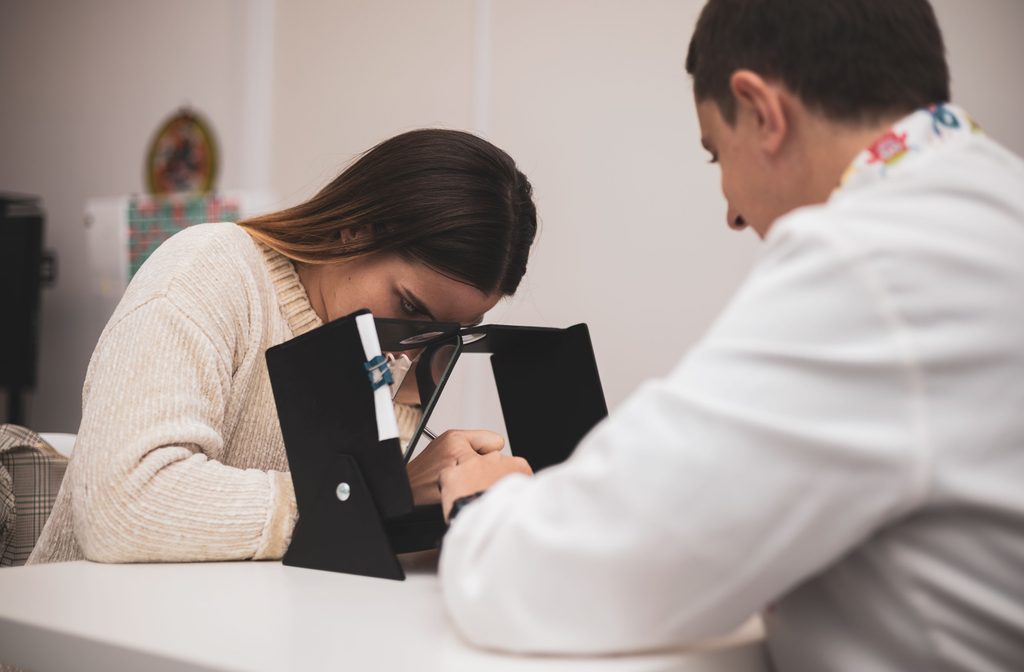
Vision therapy is different from random eye workouts online. An optometrist prescribes it after testing, builds the program around a specific diagnosis, and adjusts it as you go.
The goal is how well your eyes work as a pair and how comfortably they hold focus on close-up tasks.
Convergence insufficiency is one of the clearest examples. The eyes have trouble turning inward together for reading, and guided therapy can train that coordination.
Bring these up with your optometrist if any sound familiar:
- Double vision during reading or close work
- Headaches that build after 20 or 30 minutes of focus
- Words that seem to swim or drift on the page
- Losing your place in a line of text over and over
- One eye wandering outward when you’re tired
Kids benefit too. Better eye teaming and tracking can help a child follow a line of text without losing their place, which shows up as smoother reading and less frustration with homework.

Simple Habits to Support Healthy Eyes
None of these exercises can change your prescription, though a few habits can keep your eyes more comfortable through a long day.
Try these when screens eat up your afternoon:
- Follow the 20-20-20 rule. Every 20 minutes, look at something 20 feet away for 20 seconds.
- Blink on purpose now and then, since staring at a screen quietly cuts your blink rate.
- Keep artificial tears nearby for the gritty days.
What you do away from screens counts too. Outdoor time can slow the progress of nearsightedness in children, so send them out to play in daylight.
A plate full of leafy greens and colorful vegetables gives your eyes nutrients they use to stay healthy. On the flip side, smoking raises your risk of eye disease, and rubbing your eyes hard can irritate the cornea. Small daily habit changes add up over the years.
What an Exam Sees That You Can’t
Habits and therapy both have limits, and neither shows you what’s happening at the back of your eye.
Babies and young children benefit from baseline exams that flag problems before they start affecting learning. Adults and seniors do well with routine checkups that track changes over time and keep prescriptions current.
The real value is early detection. An optometrist can spot the quiet start of glaucoma or macular changes long before you’d notice a difference on your own.
Trade the Eye Rolls for Real Answers
Skip the circles and get a straight answer about your eyes. Book a comprehensive exam with Total Vision Pasadena, and our optometrists can tell you whether an updated prescription, vision therapy, or treatment for an eye condition makes sense for you. Book your appointment today.